
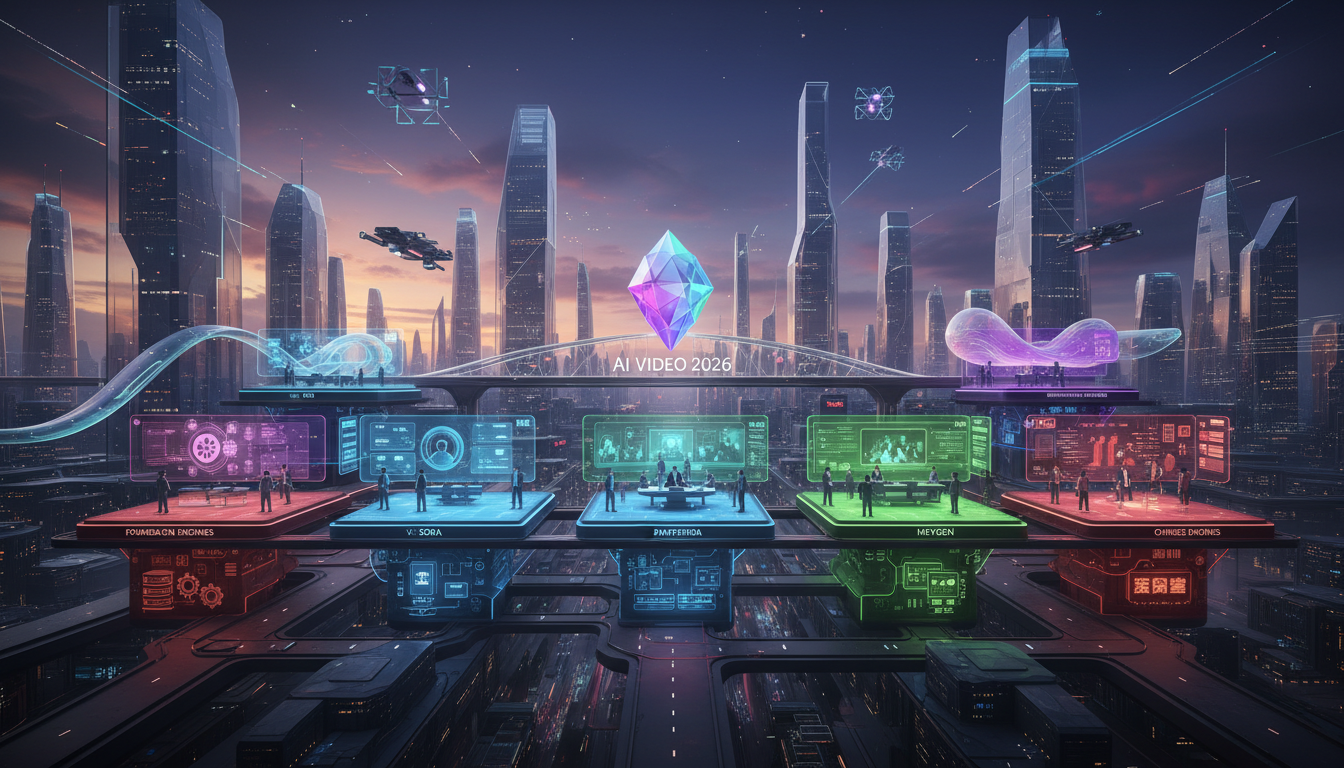
AI video in 2026 runs on stacks, not one tool: Veo, Sora, Runway, Luma, fast‑rising Chinese engines, business avatars like Synthesia and HeyGen, and experimental platforms all shine in different niches - choosing by use case is now the key skill.
The AI video space in 2026 is no longer a winner‑takes‑all market: different models dominate very specific workflows, from Hollywood‑style shorts and social clips to corporate training and experimental art. Each serious creator now ends up using a small “stack” of tools instead of betting on a single platform.
Major AI Video Engines
Four engines define the top tier of 2026 video generation.
-
Google Veo 3.1 is positioned as the most polished cinematic generator, with tightly synchronized audio and dialogue, strong handling of complex scenes, and up to 4K native output.
-
OpenAI Sora 2 focuses on single‑generation clips that stretch up to 25–60 seconds at 1080p, tuned for apps, social features, and cameo‑style content rather than full editing workflows.
-
Runway Gen‑4 leans into production work, emphasizing character and location consistency, timeline‑aware editing, and integrated 4K upscaling so editors can keep everything in one place.
-
Luma Dream Machine targets creators who need a balance between quality and accessibility, combining HDR color, 4K upscaling, and a pricing model optimized for everyday commercial use.
Fast‑Rising Chinese Models
A second cluster of tools from Chinese companies is outpacing many Western competitors on realism, motion quality, and cost.
-
KLING AI from Kuaishou is optimized for realistic human faces and lip‑sync, with 3D face and body reconstruction, facial choreography, and up to 30–40 FPS video geared for social platforms and advertising.
-
Hailuo AI (MiniMax) ranks highly on benchmarks and supplies 2D and 3D character control with 20–30 FPS output, making it attractive for animation‑style content.
-
Seedance from ByteDance focuses on multi‑shot narratives that stay consistent across scenes, blending native text‑to‑video with image‑to‑video workflows.
-
Vidu (Shengshu) aims at anime‑style and cinematic experiences, combining multi‑entity consistency, turbo diffusion for faster sampling, and high‑frame‑rate 1080p results.
Business and Experimental Video Creation
For businesses, avatar‑driven tools have matured into their own category.
-
Synthesia focuses on enterprise‑grade training and learning content, with support for hundreds of templates, many languages, and LMS‑friendly exports so teams can produce polished training videos in days instead of weeks.
-
HeyGen doubles down on ultra‑realistic “digital twins,” letting companies clone real presenters, translate them into multiple languages, and maintain consistent on‑brand appearances across campaigns.
On the creative side, several platforms help artists push boundaries.
-
Pika Labs is geared toward transformation of existing footage and images into stylized, cinematic sequences, making it popular with editors and motion designers.
-
Stable Video Diffusion, an open‑source model, offers a flexible foundation for developers and studios that want to build custom pipelines, at the cost of heavier GPU requirements.
-
Genmo Mochi targets technically advanced users, exposing lower‑level controls and a powerful model core that rewards experimentation but demands more effort to master.
Choosing the Right Tool by Use Case
Matching the tool to the project is the new critical skill for modern creators.
-
For realistic human faces and motion, KLING AI stands out as the primary choice, with Veo 3.1, Hailuo, and HeyGen as strong alternatives when projects need 3D reconstruction or rich audio.
-
For cinematic film‑style production, Veo 3.1 takes the lead thanks to its synchronized native audio and scene understanding, while Runway Gen‑4 and Sora 2 work well where long duration or timeline‑based editing matters more than raw visual flair.
-
For rapid social content and advertising, systems that maintain character consistency and handle quick, high‑FPS shots—again led by KLING and the Chinese models—give brands the agility they need.
-
For beginners, platforms with guided workflows and templates lower the learning curve so new users can get publishable clips without touching complex settings.
Pricing, Specifications, and Modalities
Pricing spreads across free tiers, invite‑only access, and high‑end subscriptions, so budgeting becomes part of the creative decision.
-
Some models offer daily free credits for experimentation, while others rely on low entry tiers plus expensive maximum plans for power users and studios.
-
Mid‑range plans around the cost of a typical SaaS subscription now deliver near‑professional output, with only the most specialized models demanding significantly higher monthly spend.
Under the hood, hard specs are just as important as branding.
-
Maximum clip duration, resolution (from 1080p to 4K), availability of native audio, and supported frame rates often determine whether a tool fits short‑form social posts, training modules, or festival‑ready shorts.
-
There is also a clear split between text‑to‑video systems, which excel at generating entire scenes and narratives from prompts, and image‑to‑video systems, which specialize in animating keyframes, concept art, or still photos into dynamic shots.